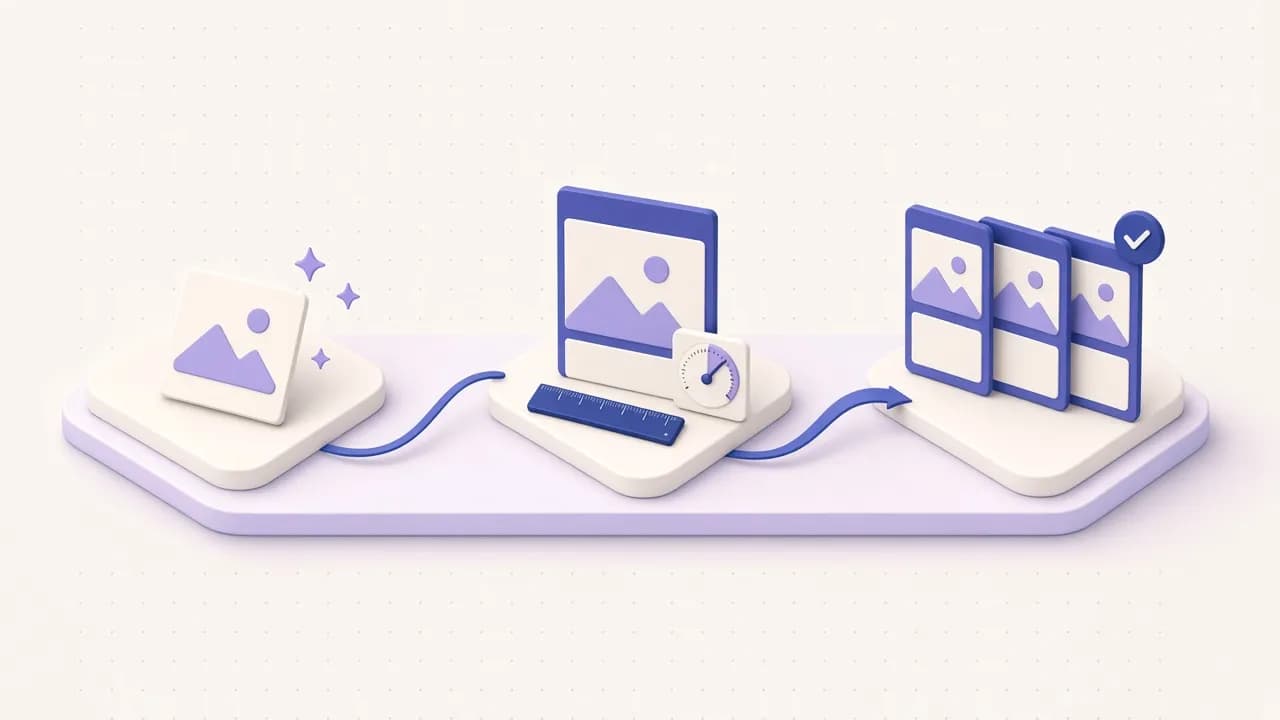
イメージディレクター Skill
視覚フォーマットを先に決めるプロンプトで、AI 画像をテストレンダーではなくポスター、表紙、カードに。
出品者:GetKits
$19 の価値がある理由
肩代わりする仕事
レンダーがテストサンプルに見えるたびに、30 点満点のスコア、欠けているレイヤー、3 つの変更を入れたフォーマット優先のプロンプトを返します。次のレンダーは運任せの再生成ではなく、狙って良くなります。
初日から使えるもの
- 24 の視覚フォーマット:比率、部品、文字ゾーン、経年の質感つき
- 30 点満点・6 観点のルーブリック:採点の目安と判定の基準つき
- 15 の「AI っぽさ」の兆候と、それを消すプロンプトの変更
- 8 パートのプロンプトテンプレート、ツール別の書き方、シリーズシート
- 実例:9/30 の素のプロンプトが 26/30 の VHS ジャケットになるまで
自分で作らずに済むもの
実在する 24 のフォーマットを部品と比率まで分解し、完成した画像とテストレンダーを見分けるルーブリックを書き、フォーマットがレンダー後も崩れなくなるまで複数のツールでプロンプトを試す作業。
イメージディレクター Kit にも含まれています。個別に買うと $57 のところ、$39 ですべて手に入ります。
その違いをご覧ください
「なぜ AI っぽいのか」にスコアで答える
ビフォー
私の Midjourney プロンプト:"silver-haired cyberpunk girl, neon city, 8K, ultra detailed, cinematic lighting, masterpiece"。何度レンダーしても、ほかの AI 画像と同じに見えます。何が足りないのでしょう?
アフター
スコア:9/30 判定:テストレンダー 足りないもの:「モノ」。ネオンのもやに浮かぶだけで、縁も、用途も、メタデータもない。 兆候:何もない背景、証明写真のような構図、品質の呪文、全体にかかったリムライト。 1. フォーマットから書き出す:"The front cover of a worn 1987 VHS slipcase for an anime video release, seen flat." 2. 部品を指定する:左端のマゼンタの背帯、上部 1/4 のタイトル枠、下部の再生時間ボックス。 3. "8K, masterpiece" を削り、1980年代後半のエアブラシ表紙イラストを様式の軸にする。
A tea launch picks its format before its picture
ビフォー
Fernway is launching Ember, a smoky winter black tea, on Instagram (4:5) and on the product page. No people, no stock-photo steam. We make images in ChatGPT. What should the image be?
アフター
FORMAT OPTIONS: Fernway Ember tea for the Instagram feed and the product page (4:5) Job: tea drinkers scrolling in November stop, read "smoky winter tea" without a caption, and tap through to the product page. | # | Format | Why it fits | Ratio | Presentation | Risk | | 1 | F08 Field guide plate (safe) | A botanical plate of the leaf, the pine smoke and the cup explains the blend with authority | 3:4, crop to 4:5 | Flat | Dramatic light; plates are flat and even | | 2 | F04 Railway-era travel poster (strong) | A winter mountain in flat lithograph planes sells a place, and the tea is the place | 2:3 | Object shot on a station wall, 4:5 | Photographic snow and haze instead of 4 to 6 color planes | | 3 | F15 Postage stamp (surprising) | A winter edition stamp with the tin as its subject marks a seasonal release | 4:5 | Flat, perforated edge, a partial November postmark | Too much detail at stamp size | Recommendation: 2. A place stops the scroll better than a product. Keep option 1 for the product page, where shoppers want to know what is in the tin. FORMAT PROMPT: F04 Railway-era travel poster for Fernway Ember (ChatGPT images, 4:5) Presentation: Object shot on a tiled station wall Prompt: A photograph of a 1930s railway travel poster pasted on a tiled station wall, the poster filling 75 percent of the frame with all four edges visible. The poster shows a snowy mountain ridge at dusk in five flat lithographic color planes, a lone pine, a thin line of smoke rising from a cabin chimney, and a small night train crossing a viaduct. The word "EMBER" runs across the top in large geometric letters; a plain cream band across the bottom 20 percent is left empty for type. A printer's credit line along the bottom edge, too small to read. The paper lifts slightly at one corner and the edges are faded where the paste dried. One cold window light from the left. Portrait, 4:5. Text to set afterwards: "Fernway Ember, smoky winter black tea" in the cream band. Price stays [confirm].
A trading card render fixed in one round
ビフォー
Midjourney, my prompt: "trading card of a goblin alchemist, card frame, stats, fantasy, highly detailed --ar 2:3". The frame came out, but the goblin fills the whole card, the stats box is missing and the name is gibberish.
アフター
REVISION: goblin alchemist card, round 1 (Midjourney, seed not used) Score: 14/30 (first audit) Verdict: Test render What the model did: "card frame" became a thin border drawn over a full-bleed painting (Boundary 2). "stats" was ignored. "highly detailed" spread detail over every inch (Restraint 2). The name came out as pseudo-letters. Changes this round (3 or fewer): 1. Part 1: "trading card of a goblin alchemist" to "a 1990s fantasy trading card, seen flat", because the subject was read first and the card second. 2. Part 2: "card frame, stats" to "a bronze frame with an art window in the top 58 percent, a blank name plate below it, an empty text box in the lower third, three empty stat slots along the bottom edge", because unnamed parts get skipped. 3. Part 6: the drawn name to a blank plate. Name and stats are set in layout, because Midjourney garbled them. Next prompt: a 1990s fantasy trading card, seen flat, bronze frame of even width on all sides, art window in the top 58 percent, blank name plate below the window, empty text box in the lower third, three empty stat slots along the bottom edge, painted gouache illustration of a goblin alchemist pouring a green tincture, waist up, filling 70 percent of the art window, cluttered workbench behind in soft detail, one candle on the left as the only light --ar 3:4 --style raw --no text, letters, rim light, particles --seed 811 Watch for: the art staying inside the window. If it bleeds over the frame, add "the painting stops at the window's edge".
Twelve cards locked into one series sheet
ビフォー
Orbit Games: we approved card 01 of our Founders set (Juno, a crane rigger). 11 more to come, one every Tuesday on X and Instagram. Our drafts of cards 02 and 03 already drifted: different frame, different light. Lock it down.
アフター
SERIES SHEET: Orbit Founders v1.0 (2026-10-05) Owner: Dana Whitlock | Items: 12 | Release: one card every Tuesday, from Tue Oct 13, 2026 Format: F13 Trading card, Flat, 3:4 uncropped Frame strategy: Drawn (the printed backer set moves to Template in v2.0) Tool: Midjourney, seed policy: fixed seed 2207 Fixed - Frame: brushed steel, about 6 percent wide on every side, 2 rivets per side - Zones: art window in the top 58 percent; blank name plate below it; empty cream text box in the lower third; three empty stat slots - Palette: steel #8A9099, cream #EFE6D2, one faction accent (Dockers #E0A23B, Drifters #3FA7A0, Wardens #B8423A) - Light: one warm key light from the upper left, shadows right, no rim light - Subject: knees up, 65 to 75 percent of the window height, facing right Why 02 and 03 drifted: 02 ran without a seed and its prompt said "metal frame", which became gold. 03 added "dramatic lighting", which brought the rim light back. Variable: {faction}, {accent}, {role}, {prop}, {background} Drift checks: 10, ticked on every render. Check 8 (one key light from the upper left, no rim light) would have caught card 03. Excerpt. The full sheet adds the base prompt with slots, the layout pass with "No. {nn}/12" and the item table.
収録内容
届くすべてのファイルと、その内容と分量です。 ファイルは英語です。
- Image Director194 行
SKILL.md
Turns a bare AI image idea into a format-first prompt that renders as a finished real-world object (a poster, a VHS case, a trading card, a case file), with its physical parts…
- AI-look audit rubric102 行
references/audit-rubric.md
The scoring rubric for every AUDIT and REVISION: six dimensions scored 1 to 5, a total out of 30 with verdict thresholds, and the 15 AI-look tells, each with the prompt change…
- Format library257 行
references/format-library.md
24 visual formats in 6 families, each broken down into its real job, native ratio, the physical parts to name, the micro metadata, where the subject sits, the type zone, the wear…
- Format picker74 行
references/format-picker.md
Decision rules for choosing 3 formats from where an image will live and what it has to do: a job-to-format table, the flat or object shot rule with the ratio math, 12 destination…
- Tool dialects75 行
references/tool-dialects.md
How to write the same FORMAT PROMPT for sentence models and tag models: per-tool notes on ratio, text, exclusions and seeds, a phrasing table that turns 10 unwanted things into…
- Format prompt template88 行
assets/format-prompt-template.md
The fill-in template for every FORMAT PROMPT: 8 parts in a fixed order, the rule for each part with a weak and a strong line, and one filled example.
- Series sheet template120 行
assets/series-sheet-template.md
The fill-in template for a SERIES SHEET: what every item shares, what changes per item, the frame strategy, a base prompt with slots, the item table, 10 drift checks for every new…
- Worked example: Neon Courier165 行
examples/vhs-courier-worked-example.md
A full worked example on one creator's project: a bare prompt that scored 9/30 becomes a Finished VHS cover at 26/30 in three renders, then gets locked as a 4-volume series sheet.
この Kit について
Turn a bare image idea into a prompt that comes out as a finished object, such as a one-sheet poster, a VHS cover, a trading card or a case file, instead of another glossy subject floating in a void. Paste any prompt or render and get a score out of 30 for the AI look, the layer it is missing and the 3 changes to make next. The skill gives your AI a visual director's judgment in Claude, ChatGPT, Codex and Cursor, and writes prompts for Midjourney, ChatGPT images, Gemini, Grok, Flux, Ideogram and Stable Diffusion. Setup takes about 5 minutes.
What you get
- Five modes in one skill. AUDIT, FORMAT PICK, FORMAT PROMPT, REVISE and SERIES, all using the same format IDs, rubric and output blocks, so the prompt you write today is scored by the same rules next week.
- A format-first prompt template. 8 parts in a fixed order: the format sentence first, then the physical structure, subject, one style anchor, wear, the type zone, exclusions and specs, with a weak and a strong line for each part.
- A library of 24 visual formats. Posters, publishing, packaging, cards, documents and photo or screen formats, each with its real job, native ratio, the parts to name, micro metadata, where the subject sits, the type zone and the wear that belongs to it.
- An AI-look rubric out of 30. Six dimensions (boundary, purpose, hierarchy, restraint, material, coherence) with scoring anchors, verdict thresholds and a fixed order for which change to make first.
- The 15 AI-look tells. Void backgrounds, ID-photo framing, quality incantations, rim light on everything, gibberish text and more, each with the exact prompt change that removes it.
- Tool dialects. How the same prompt is written for sentence models and tag models, with ratios, text limits, seeds and a table that turns 10 unwanted things into descriptions the model will follow.
- A series sheet for sets that must match, and a worked example from a 9/30 bare prompt to a 26/30 VHS cover in three renders.
Who it is for
- Creators and illustrators using AI who are tired of images that look like everyone else's.
- Marketers and founders who need launch visuals, covers and social images that look designed, without a designer on every request.
- Indie game, comic and music projects that need character cards, covers or posters that stay consistent across a series.
- Anyone who rerolls the same prompt ten times hoping the next one will be different.
What it will not do
- Generate the image. It writes and fixes prompts for the image tool you already use.
- Set your final typography. It reserves the type zone and keeps drawn text to short metadata; headlines go in your design tool.
- Copy a real brand, a living artist's signature style, a real document or a real person. Formats are described by their structure, and every issuer, seal and number is fictional.
- Promise commercial rights. Whether you can sell an image depends on your image tool's terms.
- Connect to your apps. It works on what you paste or upload.
レビュー
まだレビューはありません。